
Beyond Earth
It's not only Earth that has a magnetosphere, ionosphere, and plasma environment: all of the planets in our solar system have varied and interestingly different regimes. Even the Sun itself has a large magnetic field and plasmasphere. This tutorial aims to give an overview of each of the planets' magnetic field, and its interaction with the Sun's magnetic field - the interplanetary magnetic field (IMF). You can find out more about the Sun and Solar Wind in our Solar tutorials!
Mercury & Mars
Mercury is the closest planet to the Sun, and it has a very small and weak magnetic field (~1% of Earth's strength) produced by dynamo in the core. In combination with a thin atmosphere, this results in the solar wind sometimes impacting the surface of Mercury. However, the magnetic field is generally strong enough to keep the solar wind at bay.
In contrast, Mars has no inner dynamo creating a global magnetic field, and hence has no global magnetic field. However, remnants of iron in the surface of Mars have retained some magnetic properties. Some areas of the surface have local magnetic fields which push outwards into the solar wind's magnetic field. These areas are in the south of the planet and often protect ionospheric ions in this region.
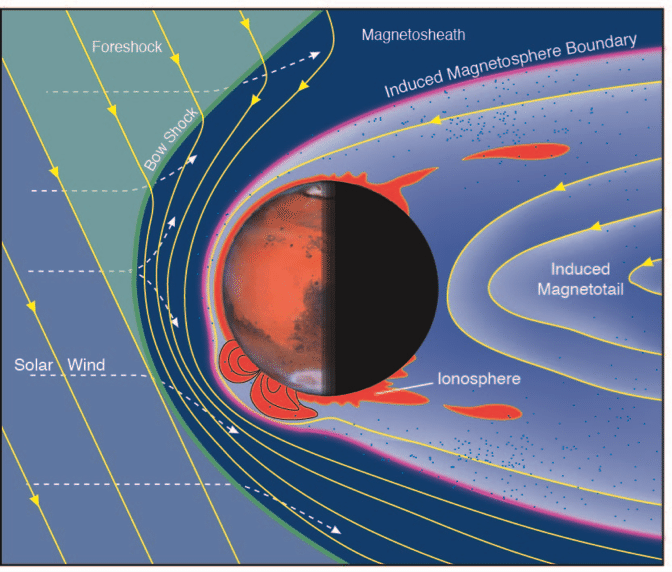
Schematic diagram of the Martian induced magnetosphere. (reproduced from Brain et al. [2017]; courtesy from Fran Bagenal and Steve Bartlett)
Venus

The solar wind interaction with Venus. From C.T. Russell, in Encyclopedia of Physical Science and Technology (Third Edition), 2003
Venus is a unique character in the solar system. The planet has no magnetic field, but volcanic activity on the surface means that it has an extended and dense atmosphere, and being closer to the Sun than Earth, this atmosphere is easily ionized. As such, Venus has a thick and dense ionosphere. The interplanetary magnetic field directly interacts with the ionosphere, however, when it comes into contact with the plasma, it becomes frozen into the ionosphere and becomes trapped. The IMF builds up in the ionosphere, causing an induced magnetosphere due to the thick ionosphere. The caught field lines slowly diffuse through the ionosphere around the side of the planet and finally out into a tail-like structure.
Jupiter & Saturn
Saturn and Jupiter are called the Gas Giants. They are both primarily made up of hydrogen and helium, and are much larger than Earth. Both rotate very quickly, at ~9 hours and ~10 hours respectively. Both planets also have a large number of moons, which in themselves create unique interactions with the magnetic field of both planets.
Io, a moon of Jupiter, and Enceladus, a moon of Saturn, are both geologically active. Io spills sulfur and Enceladus spills water molecules, which become ionized by solar radiation, and form a torus of plasma around the planet. This in turn gets 'picked up' by the large magnetic field. Due to the fast rotation and heavy torus of particles, the centrifugal force pushes the magnetic field into a disc shape. At both planets, we call this the magnetodisc.
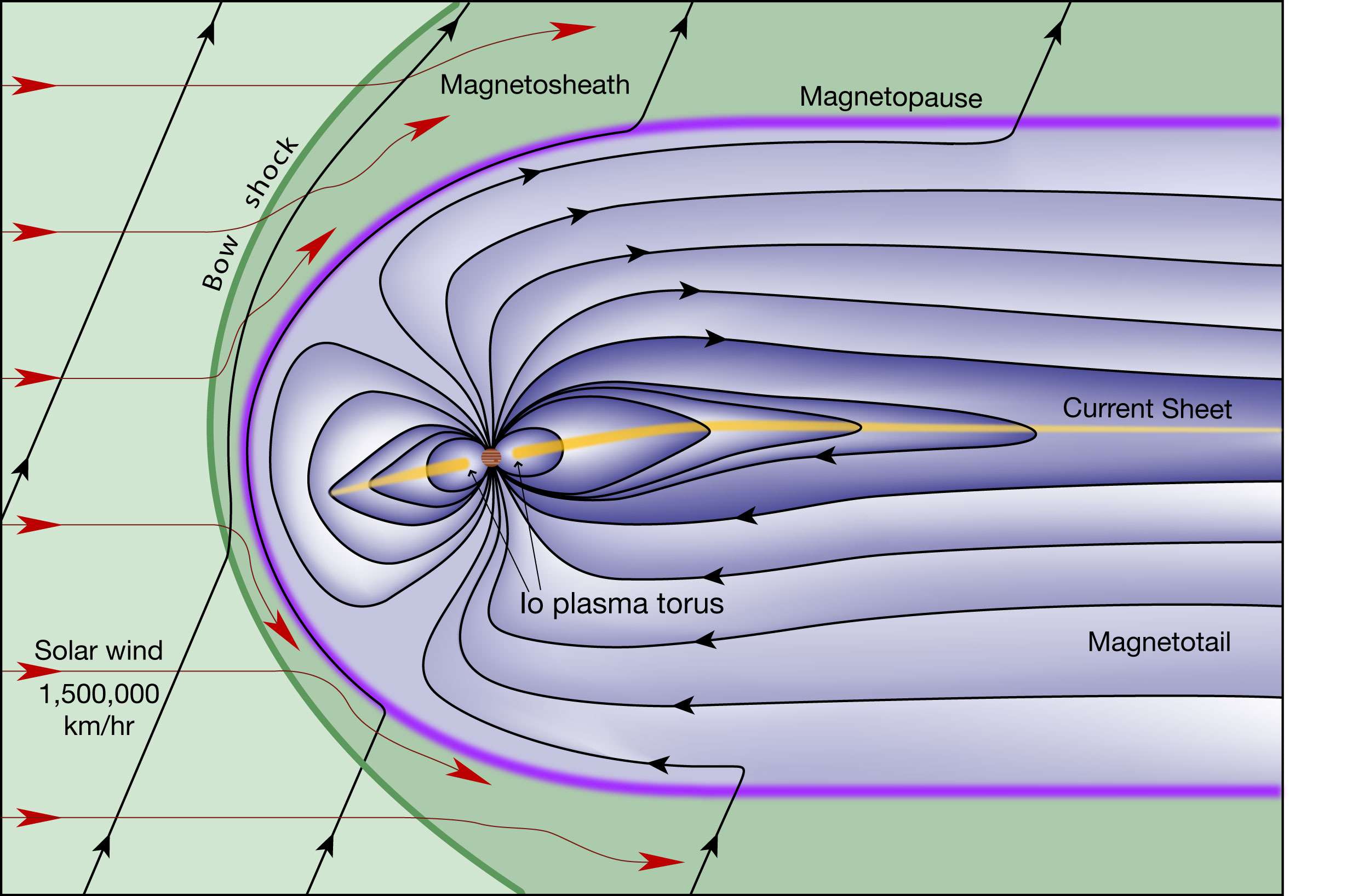
Jupiter’s Magnetosphere. Credit: Fran Bagenal & Steve Bartlett
In addition, the extra particles from the moons weigh down and make the magnetic field bend backwards from rotation. Due to these processes, the Dungey cycle is very small, slow or even none existant at times at these planets. Instead, they have the Vasyliunas cycle. The Vasyliunas cycle is another model of plasma circulation, however this model is based on the fact that the magnetospheres of Jupiter and Saturn are more rotationally-driven than solar wind-driven like the Dungey cycle.
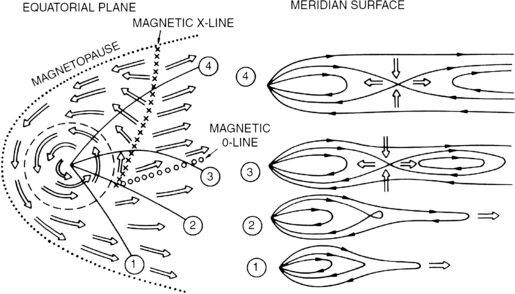
Sketch of the global flow patterns of the Jovian magnetosphere known as the Vasyliunas-cycle (from Vasyliunas 1983)
References and Reading:
- Slavin, Mercury's Magnetosphere (2004)
- Bertucci et al, The Induced Magnetospheres of Mars, Venus, and Titan (2011)
- Planetary Magnetospheres: Margaret Galland Kivelson, Fran Bagenal, in Encyclopedia of the Solar System (Third Edition), 2014
- Introduction to Space Physics by Kivelson and Russell
- Saturn from Cassini-Huygens by Michele Dougherty, Larry Esposito, Stamatios Krimigis